Santiago de Chile: how hot each street gets
5 February 2025 was a typical hot day of summer 2025 in Santiago de Chile: 32.9 °C in the air. At 16:00 the felt temperature on the streets averaged 36.2 °C. 5% of the street area was above 38 °C, the level of very strong heat stress. The rest stayed in the strong-stress band, between 32 and 38 °C.
Opens in the browser, no registration. Best on a computer.
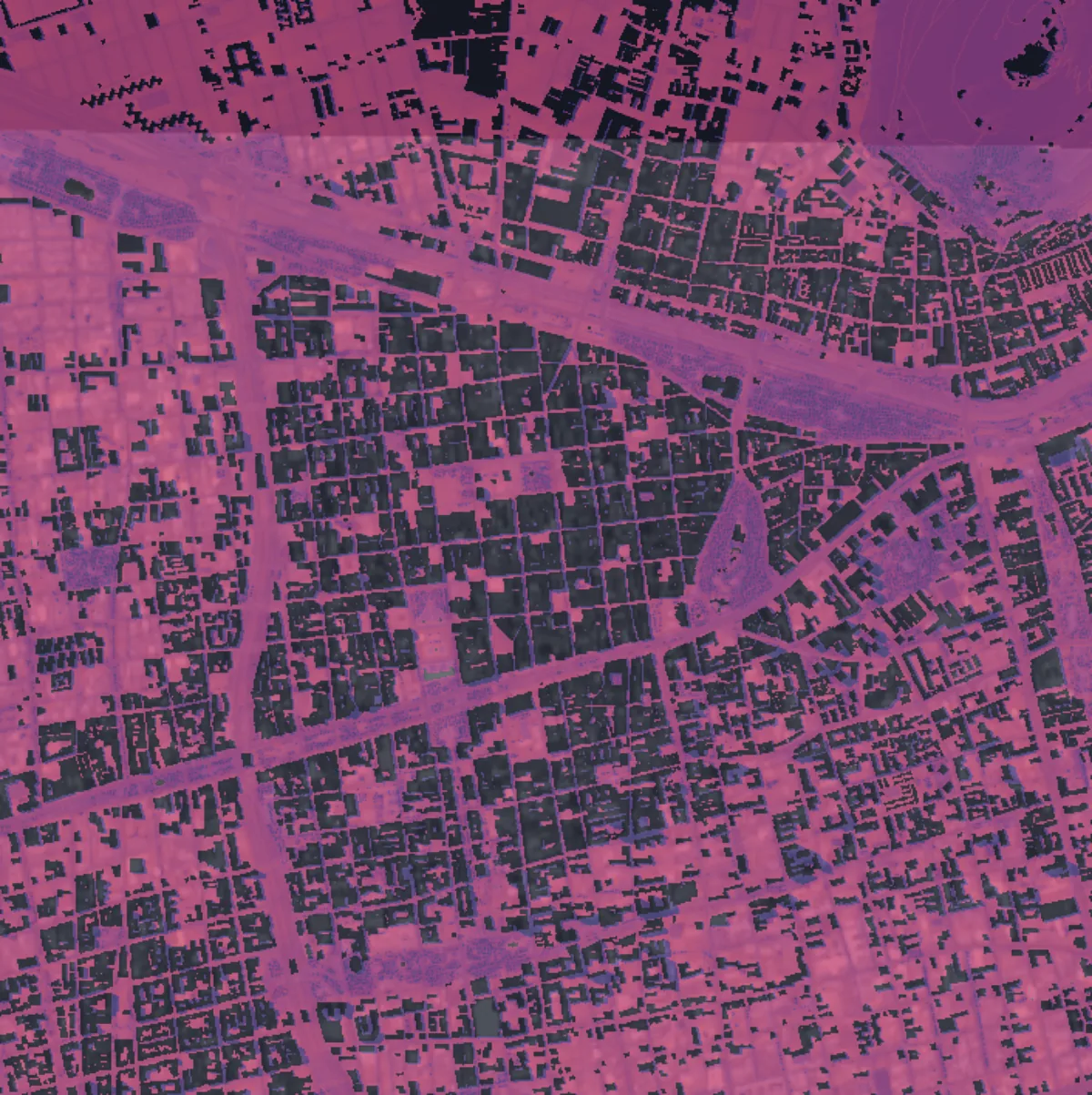
5 February 2025
UTCI
8:00–21:00
31.4 / 37.1 °C
8 February 2025 · 39.2 °C felt
In this city building heights and tree cover are estimated from global datasets, not measured. Shade is right on average along a street and less reliable for a single building.
Hottest and coolest streets
Mean felt temperature along each street at 16:00, weighted by how many people use it. The model covers 429 streets.
Hottest
- Pasaje Los Vecinos37.8 °C
- Salvador Donoso37.8 °C
- Villa El Escorial37.8 °C
- Isabel Riquelme37.8 °C
- Pasaje 137.7 °C
- Pasaje Echaurren37.7 °C
Coolest
- Paseo Ejército33.3 °C
- Nueva Rengifo33.6 °C
- Ahumada33.6 °C
- Santiago Downtown33.7 °C
- Londres33.8 °C
- Paseo Tenderini34.0 °C
What shade is worth here
At 16:00 a person standing in shade felt 31.4 °C, and 37.1 °C in the sun a few metres away. That gap of 5.7 °C is what a tree or a shade sail can give a street. At that hour 12% of the street area was in shade.
The day, hour by hour
Air temperature and mean felt temperature on the streets on 5 February 2025. The street mean did not reach 38 °C.
The climate of Santiago de Chile since 1995
Summer maximum temperatures are rising by 0.33 °C per decade (ERA5-Land, 1995 to 2025). Days above 35 °C went from 0 a year in 1995–2004 to 0 in 2016–2025. Tropical nights, with a minimum above 20 °C, went from 1 to 3. For 2050 the CMIP6 projections add 1.1 °C to the summer maximum.
What is in the model
8,358 buildings from OpenStreetMap, 9,292 trees placed from OpenStreetMap and Sentinel-2 satellite images, and 429 named streets, on a 5 m grid that covers 12.5 km² of the centre.
Model v0.2. The figures are calculated, not measured on the street, and are not yet calibrated with our own sensors. The window covers the centre of the city, not the whole municipality. Method →
Is this your city?
In a 20-minute online call we open the twin together and look at the streets you care about.